
Connect with us!
About Us
The eDNA Collaborative is a project at the University of Washington, aiming to help people around the world use environmental DNA for their own purposes. There is no fee of any kind; we do not sell anything, and neither can we provide DNA sequencing or other molecular services. There is no initiation — we just try to help people as best we can. One way we do this is by sharing information via our email listserv (occasional emails; it is not overwhelming), and to that list we send out announcements of new programs or opportunities. We are happy to feature eDNA researchers and companies of all kinds on our website, in an effort to better connect members of the global community with one another. The whole idea is that better communication and connection means that better ideas rise to the surface more quickly, helping move the science forward for everyone.
We are particularly interested in reaching people and places beyond historically well-funded settings to smooth the path to widespread use by making technology and knowledge more accessible.
The eDNA Collaborative is funded by the David & Lucile Packard Foundation, the Flora Family Foundation, the Minderoo Foundation, and Oceankind.
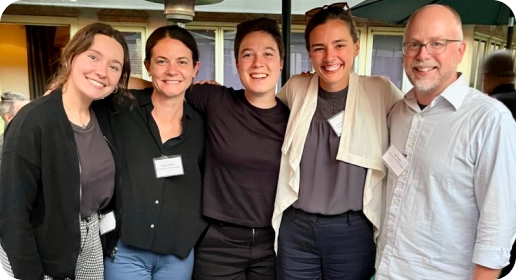
Sam Engster, Megan Shaffer, Maya Garber-Yonts, Eily Allan, and Ryan Kelly at the 2022 2nd National Workshop on Marine eDNA in Costa Mesa, CA
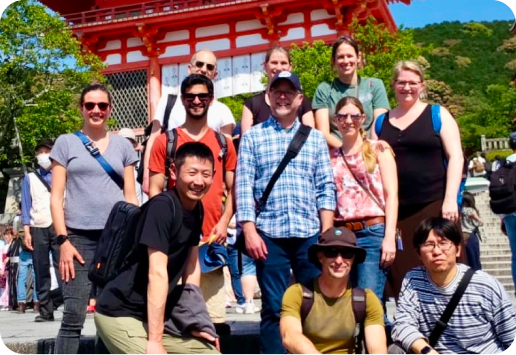
Eily Allan, Hiroki Yamanaka, Ryan Kelly and others at the 2023 eDNA Society Meeting in Shiga, Japan
Mission and Values
What We Do
Our mission is to disseminate and reinforce science that brings environmental DNA (eDNA) analysis out of the lab and into routine practice.
From 2022 to 2025, we supported a variety of programs including individual research fellows through grants and collaborations as well as connecting people worldwide to create a network of practitioners. Visit our archived Programs page to learn more about our past support.
What You Can Do
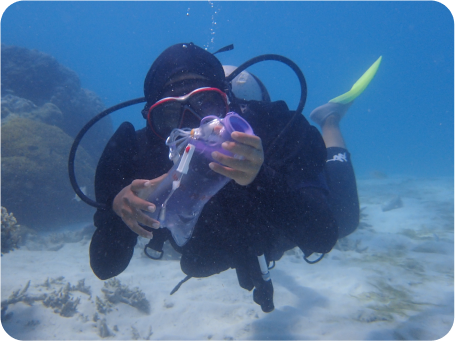
Nenik Kholilah, from Diponegoro Marine Biodiversity Laboratory, Universitas Diponegoro (Indonesia) taking a one liter seawater sample at the 5-10 meter depth using sampling pouch in Karimunjawa National Park, Central Java, Indonesia. Photo credit: M. Danie Al Malik from Fisheries and Marine Science Faculty, Universitas Diponegoro (Indonesia)
As we work to bring eDNA science into mainstream use, we need your help to connect people and spread great ideas. Please:
- Subscribe to our ListServ for information about talks, lectures, seminars and discussion groups
- Join the global eDNA Slack channel to connect with other researchers worldwide
- Highlight your eDNA research project for our Researcher Spotlight on Instagram
- Submit papers for us to publish on our Research Worldwide page
- Contribute to our Blog
- Alert us to notable publications, software, applications, meetings, and conferences
- Connect with us
Our Team
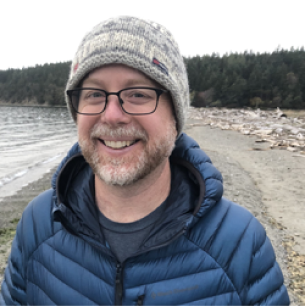
Ryan Kelly, PhD, JD
Director
Trained as both an ecologist and a lawyer, Ryan has a broad set of interests, focused both on hard scientific data and policymakers’ use of those data. His work often joins genetic and ecological research with real-world implementation in law and policy, particularly with respect to environmental monitoring, resource management, endangered species, and ocean acidification.
In general, he is drawn to projects that have significant elements of both scientific and policy relevance as we work towards more sustainable use of marine resources. Dr. Kelly received his Ph.D. in Ecology, Evolution, and Environmental Biology from Columbia University, and his JD from University of California, Berkeley, School of Law.
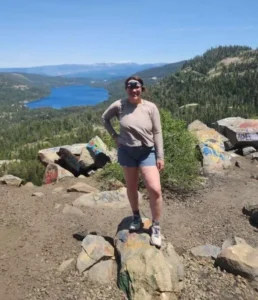
Justine Jadallah
Student Assistant
Justine works with the eDNA Collaborative as a student assistant. Prior to joining the Kelly Lab, Justine conducted research into how we can incorporate eDNA as a management method for invasive species in Washington State. She holds a B.A in Environmental Studies from the University of Washington and is currently pursuing a Master’s of Marine Affairs at the University of Washington.
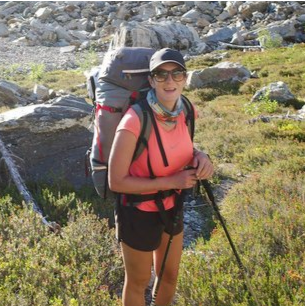
Kate Bertko
Project Manager
Kate works with both The eDNA Collaborative and on the MMARINeDNA (Marine Mammal Remote detection via Innovative environmental DNA sampling) grant which is investigating the transportation, persistence and distribution of marine mammal DNA at different spatial and temporal scales along the US West Coast.
Prior to joining the team, Kate competed and coached rowing at the collegiate and Olympic level. She holds a A.B. in Ecology and Evolutionary Biology from Princeton University.
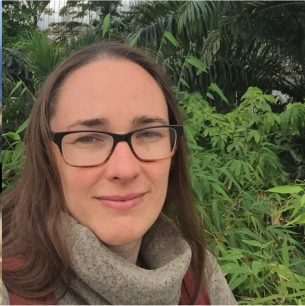
Shana Lee Hirsch, PhD
Networks and Standards
Shana is a Senior Research Scientist in the Department of Human Centered Design and Engineering at UW. She has an interdisciplinary background in sustainability, social science and ecological restoration.
Her work draws on methods and theories from human centered design and innovation studies to support accessible and usable conservation technologies. Her work with the eDNA Collaborative aims to ensure that diverse people from around the world have access to eDNA technologies.
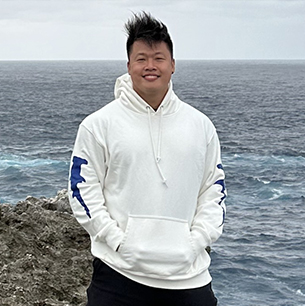
Aden Ip, PhD
Research Scientist
Aden Ip is an environmental scientist from Singapore, specializing in environmental genomics to monitor biodiversity and ecological health. He earned his PhD from the National University of Singapore. Before his current role, Aden worked on utilizing eDNA to support tracking animal diseases and trade regulations in Singapore. His research focuses on practical eDNA applications for conservation and management, developing portable detection and sequencing methods for rapid biodiversity assessments. Aden’s work aims to make eDNA analysis more accessible, efficient, and reliable for a wide range of stakeholders. Outside the lab, Aden enjoys connecting with the natural world through scuba diving, hiking, and photography. He is always eager to engage with fellow researchers and practitioners in the field of environmental science.
Frequently Asked Questions
Q: What is covered by the microgrant program?
A: It depends! The type of microgrants we offer changes every year, and there is no regular schedule for microgrant offerings. In the past we have funded eDNA workshops, conference fees, DIYNAFLUOR kits, and other small equipment. You can learn more about past microgrants at the “Past Microgrants” button above. There is not one set form of microgrant, but we are always open to suggestions from the community if you would like to leave feedback through our website or email us!
Q: I have a really cool eDNA project and need funding, does this qualify under the microgrants program?
A: We love hearing about new eDNA research happening around the world! Unfortunately, we can’t generally fund personal projects, in part because our lab is part of the University of Washington, and it is difficult or impossible to fund external projects outright.
Q: If you can’t fund my project, how can you support me?
A: We primarily offer support through our microgrants project – which varies year by year – and by spreading information about best practices and connecting people with each other to create support networks. We share information regarding our active microgrants, including information regarding materials and eligibility, through our listserv, which you can sign up for via the “subscribe to our listserv” button.
Q: If I want to be a visiting scholar, how do I apply?
A: Given our limited capacity (there are only a few of us, and often no one full-time), we can’t accept unsolicited requests to host visiting scholars. However, we are always looking for ways to have people come visit, and if you’d be interested in participating in a future visiting scholar event, please do let us know. We will independently reach out to you to offer participation in the visiting scholars program to the extent we have the capacity. We will provide updates to this page if we are accepting visiting scholars.
Q: When should I reach out to the eDNA Collaborative and how can I get support for my work?
A: We are here to connect the global community and provide support! If you want to join our global community, join our slack channel to get connected. If you are working on an eDNA project and want some technical guidance, reach out and we can try to help, either directly through collaboration or indirectly by guiding you to the right expert. Our team is small so we have limited capacity but we will certainly try our best to support you in any way that we can.
Q: How can I get involved with the eDNA Collaborative?
A: Join our listserv to stay up to date on what’s happening in our global network and stay posted on opportunities within the collaborative.
Q: What is the eDNA Collaborative and how can I join? Does it cost money?
A: The eDNA Collaborative aims to disseminate, accelerate and reinforce science that brings environmental DNA (eDNA) analysis and techniques out of the lab and into routine practice around the world. There is no application process, membership fees, or any other formalities. If you want to get involved, you can join our slack channel, join our listserv to stay connected to our work, or just email us if you want technical support or potentially want to collaborate!
Contact Us Today!
We are always interested in new people and ideas. Please feel free to reach out with questions, comments, suggestions, additions, or anything else!