
Research Worldwide: A Selection of eDNA Publications
Please note this collection is not exhaustive, and there are many eDNA publications around the world. If you would like to add your own paper or have other publication suggestions, please click the Submit Publication button below!
Publications featuring community authors
Temperature Controls eDNA Persistence across Physicochemical Conditions in Seawater
- (McCartin et al, 2022,
- Environmental Science & Technology)
Environmental DNA (eDNA) quantification and sequencing are emerging techniques for assessing biodiversity in marine ecosystems. Environmental DNA can be transported by ocean currents and may remain at detectable concentrations far from its source depending on how long it persists. Thus, predicting the persistence time of eDNA is crucial to defining the spatial context of the information derived from it. To investigate the physicochemical controls of eDNA persistence, we performed degradation experiments at temperature, pH, and oxygen conditions relevant to the open ocean and the deep sea.
Environmental DNA surveys of African biodiversity: State of knowledge, challenges, and opportunities
- (von der Heyden et al., 2022,
- Environmental DNA)
Environmental DNA surveys have become a well-established tool for detecting natural communities, showing excellent promise for supporting biodiversity monitoring, conservation, and management efforts. Africa is a continent of exceptional biodiversity, threatened not only by anthropogenic pressures but also by a general lack of research capacity and infrastructure, limiting evaluation and monitoring of ecosystems. This commentary explores the use of environmental DNA in surveying natural diversity, a rapidly moving field, within the context of capturing Africa’s natural capital.

Environmental DNA (eDNA): Powerful technique for biodiversity conservation
- (Sahu et al., 2023,
- Journal for Nature Conservation)
Environmental DNA (eDNA) metabarcoding is a non-invasive method for discovering and identifying rare and endangered species in a variety of ecosystems, including aquatic environments, based on the retrieval of genetic traces emitted into the environment by animals. Environmental (e) DNA research has grown in popularity over the last decade as a result of a rise in the number of studies that employ DNA taken from the environment, particularly in freshwater and marine ecosystems. In terms of detecting diversity patterns, we may claim that DNA retrieved from the environment (eDNA) is altering the game. For resource management in fisheries, information on species composition and biomass/abundance of commercially and noncommercially harvested species is critical. The eDNA is a truly non-invasive method that inflicts no damage on the species or habitats under study even during sampling, the eDNA technique never harms any ecosystems or threatened species. This novel molecular method never affects any endangered species or ecosystem during sampling. Environmental DNA analysis has become more widely accepted and is used in the detection of the presence and absence of aquatic macrofauna, such as freshwater and marine fish. This review study may aid researchers in better understanding the current state of eDNA technology. Despite the fact that various scientists have used eDNA to investigate the worldwide biodiversity of aquatic environments, no one in India is focusing on this new technology. We conclude that the eDNA technique has the potential to become a next-generation tool for biodiversity research and aquatic ecosystem conservation.
Comparative Decay Dynamics and Detectability of eDNA and eRNA in Connected and Isolated Freshwater Mesocosms Using Digital PCR
- (Morgado-Gamero, W. B., Tournayre, O., Cristescu, M. E. ,
- Molecular Ecology Resources)
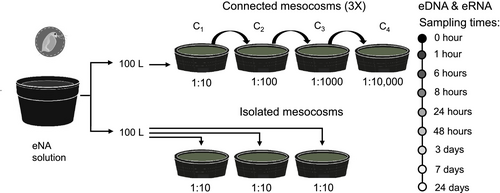
Efficient use of environmental nucleic acids (eNAs) in freshwater biodiversity monitoring requires understanding their degradation and detectability in interconnected ecosystems. We employed a novel field-scale assay to compare environmental DNA (eDNA) and environmental RNA (eRNA) decay rates and detectability across four genetic markers (16S, 18S, COI and LDHA) in connected and isolated 1000-L mesocosms containing natural planktonic assemblages. This design provides ecologically relevant and complex settings to assess how connectivity influences the detectability of eNA over time. Isolated and head mesocosms were spiked with eNAs from cultured Daphnia pulex, absent from the water source, while downstream mesocosms received eNAs via unidirectional water transfers. Using digital PCR (dPCR), we captured fine-scale temporal patterns across mitochondrial and nuclear markers and transcript types (mRNA and rRNA), an approach rarely combined in previous research. eRNA degraded significantly faster than eDNA across markers and mesocosm types. Among RNA types, mRNA (COI, LDHA) degraded faster than rRNA (16S, 18S). eRNA followed a uniform monophasic decay pattern, whereas eDNA displayed biphasic decay for nuclear markers and monophasic decay for mitochondrial markers. eNA decay rates in this field-relevant mesocosm network exceeded those from laboratory scale. While decay rates remained consistent across networks, detectability declined with dilution. Even after a 10,000-fold dilution, both eNAs were detected in terminal mesocosms, demonstrating effective transport across the network. Although RNA degrades rapidly, high detectability was achieved across diverse dilutions using dPCR, highlighting eRNA’s potential for detecting active biological communities in freshwater systems.
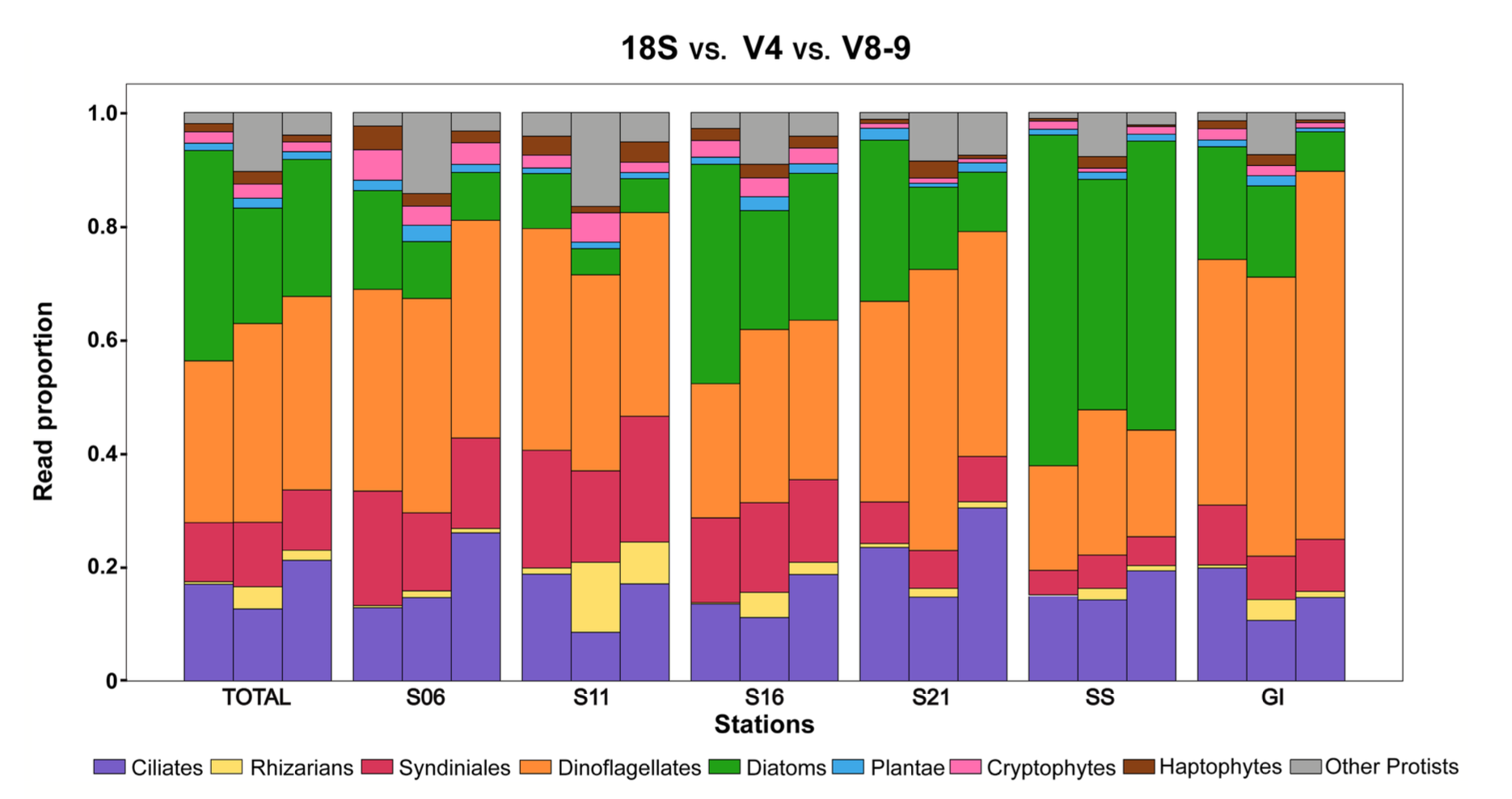
A full-length 18S ribosomal DNA metabarcoding approach for determining protist community diversity using Nanopore sequencing
- (Gaonkar, C. G., Campbell, L. ,
- Ecology and Evolution)
Efficient use of environmental nucleic acids (eNAs) in freshwater biodiversity monitoring requires understanding their degradation and detectability in interconnected ecosystems. We employed a novel field-scale assay to compare environmental DNA (eDNA) and environmental RNA (eRNA) decay rates and detectability across four genetic markers (16S, 18S, COI and LDHA) in connected and isolated 1000-L mesocosms containing natural planktonic assemblages. This design provides ecologically relevant and complex settings to assess how connectivity influences the detectability of eNA over time. Isolated and head mesocosms were spiked with eNAs from cultured Daphnia pulex, absent from the water source, while downstream mesocosms received eNAs via unidirectional water transfers. Using digital PCR (dPCR), we captured fine-scale temporal patterns across mitochondrial and nuclear markers and transcript types (mRNA and rRNA), an approach rarely combined in previous research. eRNA degraded significantly faster than eDNA across markers and mesocosm types. Among RNA types, mRNA (COI, LDHA) degraded faster than rRNA (16S, 18S). eRNA followed a uniform monophasic decay pattern, whereas eDNA displayed biphasic decay for nuclear markers and monophasic decay for mitochondrial markers. eNA decay rates in this field-relevant mesocosm network exceeded those from laboratory scale. While decay rates remained consistent across networks, detectability declined with dilution. Even after a 10,000-fold dilution, both eNAs were detected in terminal mesocosms, demonstrating effective transport across the network. Although RNA degrades rapidly, high detectability was achieved across diverse dilutions using dPCR, highlighting eRNA’s potential for detecting active biological communities in freshwater systems.
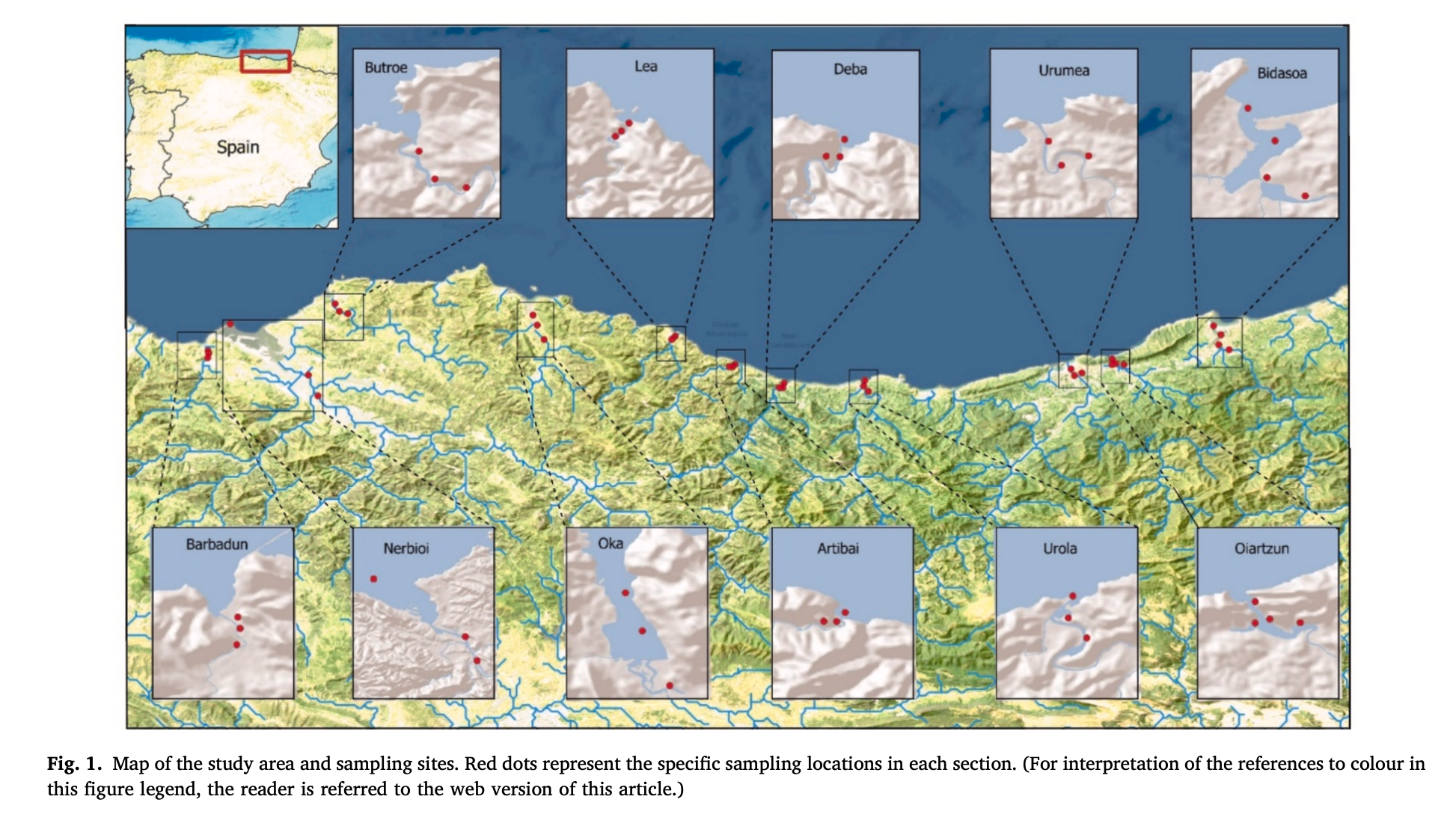
Advancing ecological assessment: towards the integration of eDNA
- (Bhendarkar, M., Canals, O., Jurado, C., Mendibil, I., Uriarte, A., Borja, A., Rodríguez-Ezpeleta, N.,
- Ecological Indicators)
In the face of increasing anthropogenic pressures on estuarine ecosystems, methods to efficiently and reliably assess their ecological status are essential. This study explores the integration of environmental DNA analysis into the AZTI’s Fish Index (AFI) to assess ecological status of estuarine ecosystems. Surface water eDNA sampling and bottom trawl surveys were performed across multiple estuaries in the Basque Country, Spain, and resulting species data were used to calculate AFI scores. eDNA metabarcoding consistently detected higher fish species richness than bottom trawling, while the latter remained more effective at capturing demersal species. In general, ecological classifications from eDNA- and bottom trawl derived data displayed low concordance, largely due to differing species assemblages and metric contributions. These results emphasize the respective strengths and weaknesses of each methodology and the necessity for method-specific calibration. Considering that the AFI is calibrated using bottom trawl data, its direct application to eDNA-derived species lists may lead to some inconsistencies. This study underscores the critical necessity to establish eDNA-specific reference conditions and to recalibrate index thresholds accordingly. While eDNA approach may not entirely replace traditional methods, its scalability, sensitivity, and minimal ecological disturbances establish it as an essential complementary application within monitoring programs. This research strongly supports the urgent advancement of eDNA-based indices and the critical enhancement of reference conditions for their effective incorporation into ecological assessment frameworks under the Water Framework Directive.
Publications featuring eDNA Collaborative authors
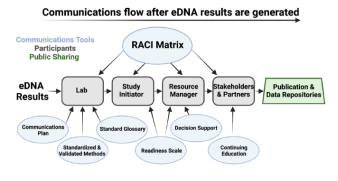
Critical considerations for communicating environmental DNA science
- (Stein et al, 2023,
- Environmental DNA)
The economic and methodological efficiencies of environmental DNA (eDNA) based survey approaches provide an unprecedented opportunity to assess and monitor aquatic environments. However, instances of inadequate communication from the scientific community about confidence levels, knowledge gaps, reliability, and appropriate parameters of eDNA-based methods have hindered their uptake in environmental monitoring programs and, in some cases, has created misperceptions or doubts in the management community. To help remedy this situation, scientists convened a session at the Second National Marine eDNA Workshop to discuss strategies for improving communications with managers.
Improved biodiversity detection using a large-volume environmental DNA sampler with in situ filtration and implications for marine eDNA sampling strategies
- (Govindarajan et al, 2022,
- Deep Sea Research Part I: Oceanographic Research)
Metabarcoding analysis of environmental DNA samples is a promising new tool for marine biodiversity and conservation. Typically, seawater samples are obtained using Niskin bottles and filtered to collect eDNA. However, standard sample volumes are small relative to the scale of the environment, conventional collection strategies are limited, and the filtration process is time consuming. To overcome these limitations, we developed a new large – volume eDNA sampler with in situ filtration, capable of taking up to 12 samples per deployment.
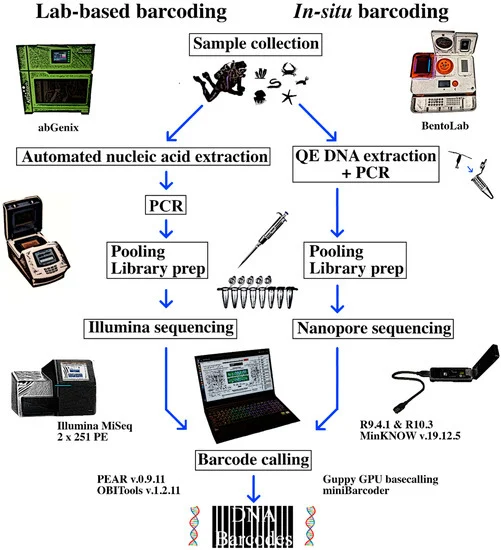
Takeaways from Mobile DNA Barcoding with BentoLab and MinION
- (Chang et al,
- 2020, Genes, Special Issue: MetaGenomics Sequencing In Situ)
Since the release of the MinION sequencer in 2014, it has been applied to great effect in the remotest and harshest of environments, and even in space. One of the most common applications of MinION is for nanopore-based DNA barcoding in situ for species identification and discovery, yet the existing sample capability is limited (n ≤ 10). Here, we assembled a portable sequencing setup comprising the BentoLab and MinION and developed a workflow capable of processing 32 samples simultaneously.
Want to share your new eDNA research with the global community? 🌎📸🌟
We are always interested in making eDNA research more accessible, so we welcome publication suggestions (yours or someone else’s)! Please feel free to fill out this form and share some information about your paper. We might post about it!